Rotate List
LeetCode 61 | Difficulty: Medium
MediumProblem Description
Given the head of a linked list, rotate the list to the right by k places.
Example 1:
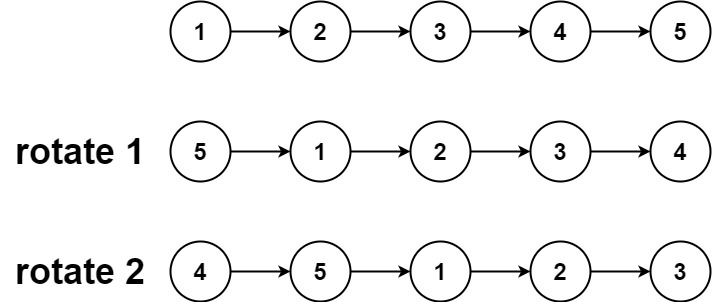
Input: head = [1,2,3,4,5], k = 2
Output: [4,5,1,2,3]
Example 2:
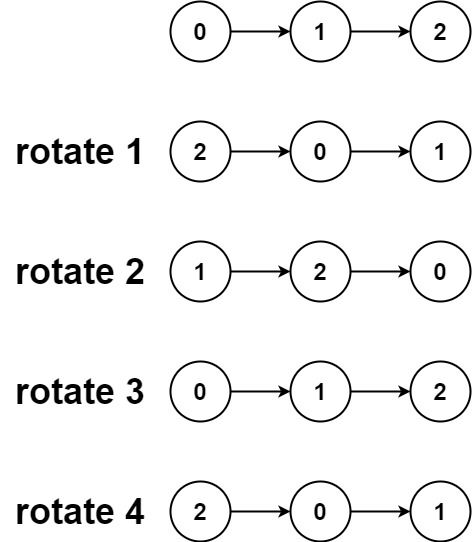
Input: head = [0,1,2], k = 4
Output: [2,0,1]
Constraints:
-
The number of nodes in the list is in the range
[0, 500]. -
-100 <= Node.val <= 100 -
0 <= k <= 2 * 10^9
Topics: Linked List, Two Pointers
Approach
Linked List
Use pointer manipulation. Common techniques: dummy head node to simplify edge cases, fast/slow pointers for cycle detection and middle finding, prev/curr/next pattern for reversal.
When to use
In-place list manipulation, cycle detection, merging lists, finding the k-th node.
Solutions
Solution 1: C# (Best: 162 ms)
| Metric | Value |
|---|---|
| Runtime | 162 ms |
| Memory | N/A |
| Date | 2017-09-19 |
Solution
/**
 * Definition for singly-linked list.
 * public class ListNode {
 *     public int val;
 *     public ListNode next;
 *     public ListNode(int x) { val = x; }
 * }
 */
public class Solution {
    public ListNode RotateRight(ListNode head, int k) {
        if(head==null || head.next == null) return head;
		ListNode tail = head, current = head;
		int length = 1;
		while (tail.next != null)
		{
			length++;
			tail = tail.next;
		}
		k = k % length;
		if(k==0) return head;
		for (int i = 0; i < length-k-1; i++)
		{
			current = current.next;
		}

		var newHead = current.next;
		tail.next = head;
		current.next = null;
		return newHead;
    }
}
📜 1 more C# submission(s)
Submission (2017-09-19) — 162 ms, N/A
/**
 * Definition for singly-linked list.
 * public class ListNode {
 *     public int val;
 *     public ListNode next;
 *     public ListNode(int x) { val = x; }
 * }
 */
public class Solution {
    public ListNode RotateRight(ListNode head, int k) {
        if(head==null || head.next == null) return head;
		ListNode temp = head;
		ListNode slow = head, fast = head;
		int length = 0;
		while (slow != null)
		{
			length++; slow = slow.next;
		}
		k = k % length;
		if(k==0) return head;
		slow = temp;
		for (int i = 0; i < k; i++)
		{
			fast = fast.next;
		}
		while (fast.next != null)
		{
			slow = slow.next;
			fast = fast.next;
		}
//		slow.Dump("slow");
//		fast.Dump("fast");
//		temp.Dump("temp");
		var newHead = slow.next;
		fast.next = temp;
		slow.next = null;
		fast = temp;
		return newHead;
    }
}
Complexity Analysis
| Approach | Time | Space |
|---|---|---|
| Two Pointers | ||
| Linked List |
Interview Tips
Key Points
- Discuss the brute force approach first, then optimize. Explain your thought process.
- Draw the pointer changes before coding. A dummy head node simplifies edge cases.